Introduction
When looking after live plants, it is essential to ensure they grow well and yield a bountiful harvest. As a passionate gardener, and a tech enthusiast at the same time, closely monitoring the conditions within my greenhouse was a no brainer; for it gave me the opportunity to merge two things I love doing. It provided me with the ability to create an ideal environment for my plants, reducing stress and maximising their growth potential.
In this blog post, I will share my insights on how I monitor and maintain the conditions in my greenhouse. In caring for a greenhouse, there are three primary conditions I pay close attention to: temperature, humidity, and soil moisture content. These factors play a vital role in the overall well-being of the plants. Monitoring and controlling these conditions contribute to their health, productivity, and resilience.
Disclosure
This blog post contains affiliate links. If you click on an affiliate link and make a purchase, I may earn a commission at no extra cost to you. Please note that I only recommend products and services that I have personally used and found valuable in my gardening journey.
Conditions
Temperature
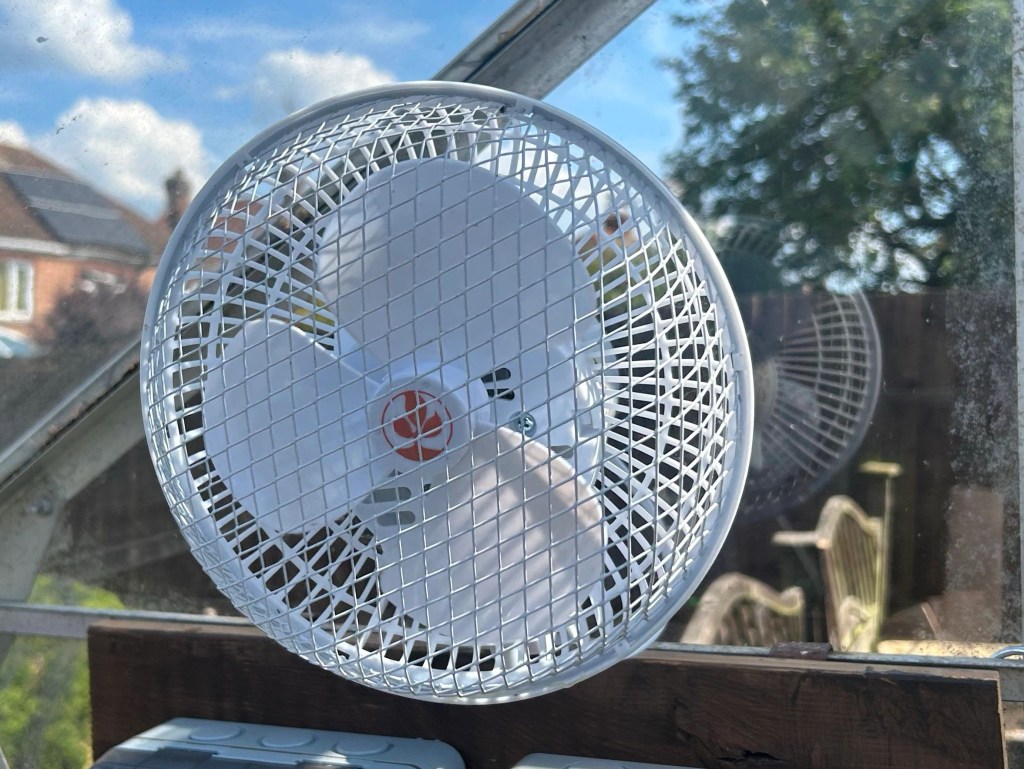
The temperature of a greenhouse is a critical factor that affects not only the plants but also the moisture levels within them. When the temperature rises too high, plants can experience heat stress, causing wilting, reduced growth, and even damage to their cellular structure. Conversely, when temperatures drop too low, plant growth can slow down, and frost or freezing temperatures may harm sensitive plants. It is crucial to maintain optimal temperature levels throughout the day and night to provide an environment conducive to healthy plant development. It is said the best temperature range for the greenhouse is between 18 to 24 degrees. Usually when the temperature of my greenhouse gets quite high, my system automatically turns on the fan, and I am instructed to open the doors if closed.
Humidity
Maintaining the right humidity levels within a greenhouse is equally vital. Humidity affects not only the plants themselves but also the moisture content in the soil. Low humidity can lead to increased moisture evaporation from both plants and soil, potentially damaging the crops. It can cause wilting, stunted growth, and nutrient deficiencies. On the other hand, excessive humidity can create a damp environment that fosters the growth of mold, mildew, and fungal diseases. Proper humidity control ensures optimal moisture balance for plants, promoting healthy growth and preventing the onset of diseases. It is said the best humidity range for a greenhouse is between 40 to 80%. When the humidity gets very low, my misting system automatically comes on to increase it. You can read about my misting system below:
How I built my Misting System
Soil Moisture
Adequate soil moisture is essential for plant health as it serves as the primary source of water and nutrients. Insufficient moisture can result in drought stress, wilting, nutrient deficiencies, and reduced growth. Insufficient moisture also hampers the soil’s ability to deliver nutrients effectively to the plant’s roots. However, overwatering can be equally detrimental, leading to poor oxygen availability in the root zone and root rot. Striking the right balance is crucial to provide plants with sufficient hydration without suffocating their roots. Due to mulching, I hardly have any issues with soil moisture, so it’s been consistently stable. But if needed, the same misting system will be activated to raise it up.
Conditions Monitoring
To effectively monitor these conditions, I have developed my own system using market-bought sensors and software integration. Here’s how I utilise sensors for each condition:
Humidity and Temperature
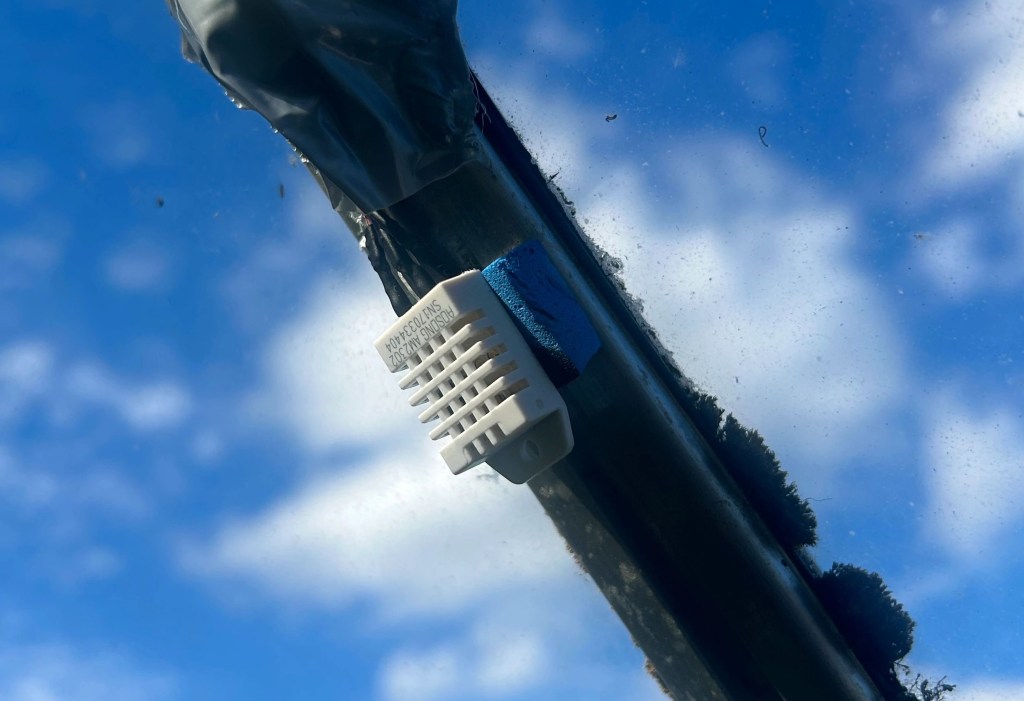
I use a single sensor to track both the humidity and temperature conditions of my greenhouse, ensuring the sensor is placed in a spot that is central to the greenhouse. This allows me to make informed decisions about ventilation, shading, misting and heating (in future) to maintain optimal temperatures and humidity for plant growth. This sensor is placed closer to the roof of the greenhouse, so I get the readings at the top as the heat rises.
Soil Moisture and Temperature
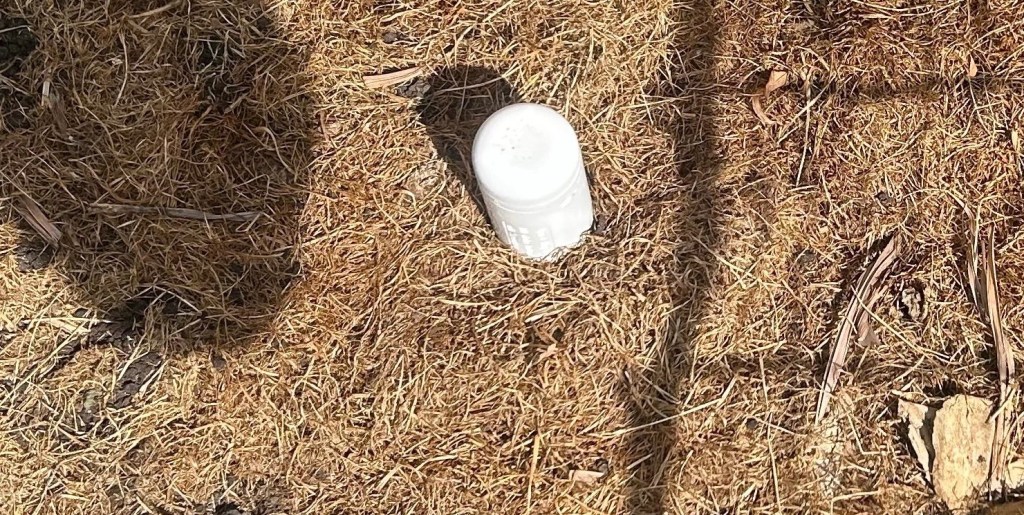
Utilising soil moisture sensors, I can accurately gauge the moisture content within the soil. These sensors help me determine the right watering schedule and avoid under or overwatering. The data collected allows me to optimize irrigation practices and ensure my plants receive the right amount of moisture for healthy growth. This sensor also comes with a temperature senor, which I use to know the temperature of the soil at the ground level closer to the plants.
Door and Window
The greenhouse has a door (or course), and a top vent window which is unfortunately not under my control. The top window vents makes use of a mercury based lever to open and close it, which is dependent on the heat in the greenhouse. I also have sensors on the door and window, which reports to me when the vent/door is opened. So if for example the greenhouse is very hot and the door is closed, I am informed to ensure its opened.
Visualizing and Analysing the Data
With the help of software integration, all sensor data events are collected, streamed to a server to be stored in a database and then analysed in real-time. This allows me to have a comprehensive overview of the greenhouse conditions at any given moment. The software also provides valuable insights, trends, and customizable alerts, enabling me to take immediate action when necessary.
Monitoring and adjusting these crucial greenhouse conditions based on sensor data significantly improves the overall health and productivity of my plants. It minimizes stress, optimizes growth, and maximizes the potential for a successful harvest.

Alerting and Control
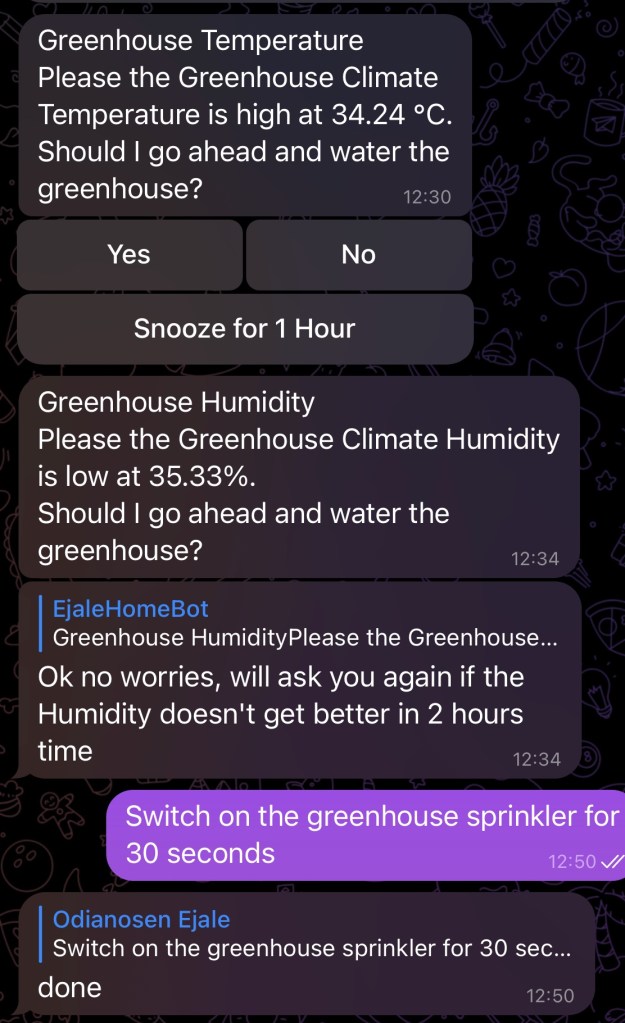
When there is an issue, or the state of the monitored condition is bad, I get alerted of what is going on. Also I don’t think I like the idea of the misting system completely running on its own (at least not yet), depending on what is going on; though if the condition is extreme, it handles it on its own. Even every morning watering, I have it ask me if to go ahead as sometimes I might have watered them the previous evening using fish waste. So since I need a way to be reached no matter where I am, I needed a way to be accessible by my system and send instructions back when needed.
For this reason I integrated the Telegram messaging platform into my automation system, so via it I can be alerted of what is going on and take action based on conditions. Telegram allows to create bots on the platform, which can be programmed to interact with users. This gives the ability to send commands back (call back commands) from within a chat with a bot, which can be replied to via inline buttons made available by the bots.
There are instances I am right within the greenhouse, and I just want to switch on/off the fan or misting system manually. Having to bring out my phone just to do this, of course is not really convenient while I am in there. For this reason I also integrated a push button, that when pressed the systems can be controlled if one is right within the greenhouse.

To make the control of all these things possible, I have a power device controller which is kept within the above shown waterproof electrical box. Its essentially a WiFi development board (NodeMCU), running a open source firmware on it (Tasmota) with some custom configuration, and connected to a relay board. The setup allows to be controlled wirelessly (remotely), or via local switches. I purchased the momentary switches, drilled the required holes into the box and fitted them in. The switches are also waterproof, ensuring they don’t get bad due to occasional high humidity in the greenhouse. Links to the board, relay and switches can be seen below.
Software Components
This section is for the geeks that might be interested in what software components are being used, to run the setup:
| Component | Used for |
| Appdaemon | Automation framework, and the brain behind everything. Collects, processes and stores all data, while making decisions based on them |
| Tasmota | Open source firmware for ESP devices |
| Zigbee2Mqtt | Transforms the data from the devices using the zigbee protocol, and restreams them using the MQTT protocol |
| InfluxDB | Timeseries Database, used to store the processed data from the sensors |
| Eclipse Mosquitto | MQTT broker, used for intersystem communication over the network |
| Grafana | For observability, visualisation, and analysis. Also used for setting up some alerts |
| Telegram | The ChatBot, used for communicating with me and receiving instructions back |
Conclusion
Closely monitoring and maintaining optimal conditions in my greenhouse for me is vital for successful plant growth. By monitoring temperature, humidity, and soil moisture content, I can create an environment that nurtures healthy plants and hopefully maximizes my harvest. Investing in sensors and software integration allows for accurate and real-time monitoring, empowering me to make informed decisions and take timely actions. Also cannot remove the fact its just so much fun.
There is still some work to be done though, as since my misting system uses a water reservoir, there is need to know real-time the water level. This will prevent the pump from running, when the water level is too low and inform me of the situation. As stated above the top vent window is out of my control, well needs to get under my control. I got an extractor fan I bought for the greenhouse, have not figured out yet how to install it since its all glass. So watch this space for updates, as I go via solving these various issues.
Lastly remember, every greenhouse is unique, and experimentation will help you fine-tune your monitoring system to suit your specific plants and local climate. Embrace the process of learning, adapting, and refining your greenhouse management techniques to unlock the full potential of your gardening endeavours. If you have any questions, or have tried something like this, do kindly put it in the comment section, so we all can learn from your experience. Happy gardening!
 Gardening, Tech and DIY